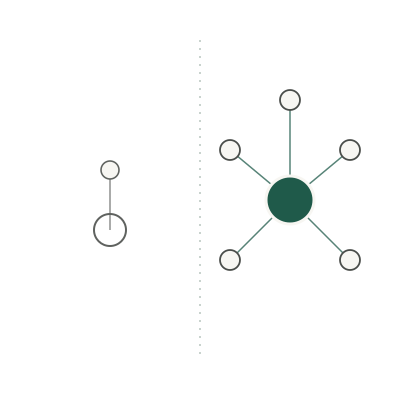
An IT Manager and a fractional CTO or CIO can sit in the same organisation without ever competing for the same job. One keeps the systems running today. The other decides what the technology function should look like in two years and carries the risk of getting that wrong. Confusing the two roles is why many growing organisations end up with neither properly covered.
The confusion is understandable. Both roles talk about technology all day. Both sit in leadership meetings occasionally. But the altitude they operate at, and what they're accountable for, are completely different.
What an IT Manager is accountable for
An IT Manager runs operations: helpdesk tickets, patching, user provisioning, the relationship with your managed service provider, keeping the network and the applications people rely on actually working. It is a full-time, hands-on role focused on today. Good IT Managers are essential, and a lot of growing organisations underinvest in this layer just as much as they underinvest in leadership.
What an IT Manager is not typically resourced, mandated or positioned to do is set multi-year strategy, own cyber risk at a board level, or make the trade-off calls between competing investments. That is not a skills gap so much as a scope gap: it is a different job.
What a fractional CTO or CIO is accountable for
A Fractional Technology Executive engagement sits a level above operations. The focus is the roadmap, the risk posture, the vendor and licensing spend, and translating all of it into something the board and the leadership team can actually act on. The IT Manager reports on what happened this week. The fractional CTO or CIO is accountable for whether the technology function is heading somewhere sensible at all.
One role keeps the lights on. The other decides which building you should be in.
Where the two roles overlap, and where they don't
They overlap in one place: both care whether systems work. Beyond that, the responsibilities diverge sharply. Strategy, board reporting, cyber governance and vendor negotiation sit with the fractional executive. Day-to-day support, ticket queues and keeping the MSP relationship functional sit with the IT Manager. A Technology Executive Diagnostic is often the fastest way to see exactly where that line currently sits in your organisation, and where it's blurred in a way that's creating risk.
The strongest set-ups have both roles working together: the IT Manager executing well against a plan, and the fractional executive making sure that plan exists and is the right one. Neither role substitutes for the other.
| Dimension | IT Manager | Fractional CTO or CIO |
|---|---|---|
| Time horizon | This week, this ticket queue | The next 12-24 months |
| Core accountability | Systems stay up and running | The technology function is heading somewhere sensible |
| Typical work | Helpdesk, patching, provisioning, MSP relationship | Roadmap, risk posture, vendor negotiation, board reporting |
| Decision scope | Operational, day-to-day | Strategic, trade-offs between competing investments |
| Reports to | Whoever owns technology internally, often the fractional CTO or CIO once one is in place | The board or leadership team |
| Engagement type | Full-time, hands-on | Fractional, engaged for the leadership needed |
The cost most organisations miss
Vendor and licensing spend is a good example of where the gap shows up. An IT Manager can flag that a renewal is coming up. Renegotiating the commercial terms of that contract, understanding what leverage exists, and deciding whether to switch providers entirely is a different kind of work again, strategic commercial negotiation, not day-to-day administration. It's the same consistent commercial acumen, and the same category of outcomes, that a fractional CTO or CIO brings to every vendor relationship they touch, not a change in usage, a change in who was negotiating.
That is squarely a fractional CTO or CIO responsibility, and it is one of the more common reasons organisations bring one in even when their IT Manager is doing a perfectly good job.
What happens when the gap goes unfilled
Without a fractional CTO or CIO, the strategic decisions don't disappear, they just get made by default: by whichever vendor is easiest to renew with, by whoever asks loudest for budget, or by an IT Manager stretched into a strategic role they were never resourced or mandated for. None of those are anyone's fault. It's simply what happens when a layer of accountability is missing.
The result is usually the same pattern: technology spend creeping upward without a clear rationale, cyber risk nobody in the room can quantify, and a board asking questions that go unanswered because no one owns the answer.
How to tell which one you actually need
If your systems are unreliable, support requests go unanswered, or day-to-day operations feel shaky, the gap is an IT Manager or a stronger MSP relationship. If systems mostly work but no one can say with confidence what the technology roadmap is, how exposed you are to a cyber incident, or whether current spend represents good value, the gap is a Technology Strategy & Transformation engagement led by a fractional CTO or CIO. Most growing organisations eventually need both, just not necessarily at the same time.
The bottom line
An IT Manager and a fractional CTO or CIO aren't competing for the same job, and hiring one doesn't make the other redundant. One keeps today running. The other makes sure there's a plan worth running toward, and someone accountable for it when the board asks.
Frequently asked questions
What's the core difference between an IT Manager and a fractional CTO or CIO?
An IT Manager runs day-to-day operations: support, patching, provisioning and the MSP relationship. A fractional CTO or CIO operates a level above, owning strategy, cyber risk, vendor negotiation and board reporting. One keeps systems running today; the other is accountable for where the technology function is heading.
Does hiring a fractional CTO or CIO mean I don't need an IT Manager?
No. The two roles cover different work and neither substitutes for the other. The strongest set-ups have both: an IT Manager executing well day to day, and a fractional CTO or CIO making sure there's a sound strategy for them to execute against.
Can my existing IT Manager grow into a fractional CTO or CIO role?
It's possible over time, but the two roles require different scope, mandate and often different experience, so it isn't automatic. Most organisations keep the roles separate and complementary rather than expecting one person to absorb both at once.
Who should an IT Manager report to once a fractional CTO or CIO is in place?
Typically the fractional CTO or CIO, at least for strategic direction and prioritisation, while day-to-day operational reporting can stay wherever it already sits. The goal is a clear line between who sets the plan and who executes it.
Ken Blaszkowski
Ken is an enterprise technology executive with two decades of experience across digital transformation, cyber security, data strategy and AI enablement, including roles as Group CTO and Group CIO. He writes about giving growing organisations the technology leadership they need. Connect on LinkedIn.